


On March 26, 2026, the San Mateo Union High School District (SMUHSD) Board of Trustees voted unanimously to implement a districtwide “bell-to-bell” cellphone policy starting next school year. Under this policy, students will not be able to use their phones for the whole school day.
Previously, the district had each school establish its own policy. Many schools, Mills included, only limited phone use during instructional time, leaving enforcement to teachers. In contrast, San Mateo and Peninsula High Schools already had a bell-to-bell policy using Yondr pouches, where phones are kept in magnetically locked pouches.
This change was sparked by the Phone-Free School Act (Assembly Bill No. 3216), which requires all California schools to adopt a policy limiting or prohibiting the use of cellphones before July 1, 2026. The bill does note a few specific exceptions: students must be allowed to use their phones in case of an emergency or perceived threat or as allowed by a teacher, administrator, doctor or a student’s Individualized Education Program (IEP).
The new phone policy is part of a larger movement limiting school cellphone use across the country, with 22 laws enacted in 2025 alone.
Developing a Policy
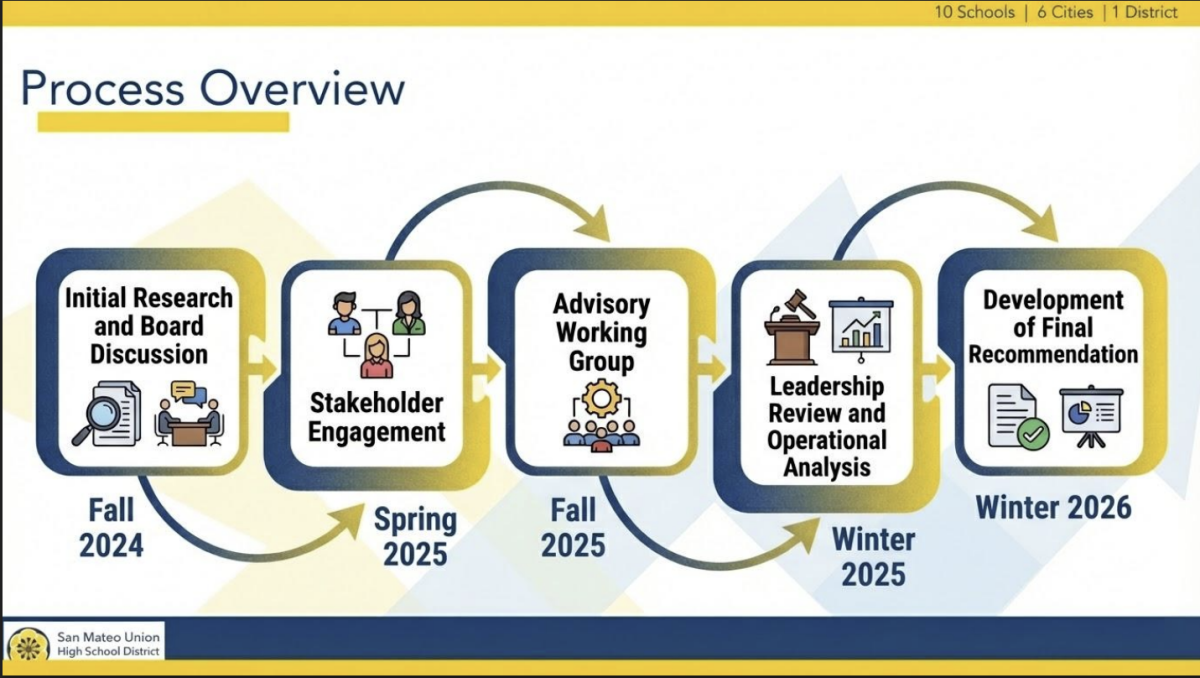
Discussion about updating the district’s cellphone policy began in 2024. The district sent out surveys about phone use and organized a cellphone working group composed of students, parents, teachers and administrators.
“We would be split into little breakout groups [with] an admin from a school or a teacher, and then a student, [so] you get all those perspectives out,” says Dylan Lee, a senior at Capuchino High School and a member of the working group.
The group, which met once a month throughout the fall of 2025, did extensive research on student cellphone use, potential policies, cost and implementation. Overall, the working group supported a bell-to-bell policy for many reasons, the first being social engagement.
“I think the biggest thing was the social interaction,” says Lee. “From many teachers’ perspectives, they were really advocating for social connection and just better concentration and focus in class.”
Burlingame High School sophomore Noah Robinson says he initially favored only banning phones during instructional time, but participating in the working group changed how he saw the use of phones and technology at school.
“After the first [working group meeting], we were instructed to keep [our] eyes out for cellphone use and then report back on … what [we] see. And I realized just how many people are on their phones next to their friends during lunch,” Robinson says. “That first day, I saw so many people watching TikTok next to people that I know that they would talk to if their phones weren’t there.”
The loss of instructional engagement and the pressure placed on teachers to enforce the cellphone policy also directed administrators toward a bell-to-bell policy. According to a Pew Research Center study, 71% of high school teachers say their school or district has a cellphone policy, but out of those, 60% say that the policy is very or somewhat difficult to enforce. Surveys conducted by SMUHSD reveal similar trends, with 66.1% of educators supporting a bell-to-bell ban.
Valerie Cañas-Gonzalez, an English teacher at Mills, says the current cellphone policy can feel like a “losing battle” for both students and teachers.
“There are phone pockets and things like that, but in a way, it makes teachers feel like we’re policing as opposed to being educators and supporting our students,” she explains.
Robinson has a similar opinion. “I think that it really weakens the relationships between teachers and students as a lot of the time teachers will have to get on kids’ backs about following the phone policy,” he says. “I think that making it so that it’s the teacher’s job to enforce the policy … makes it a lot easier for students to get upset at teachers.”
Cañas-Gonzalez observes that restricting phone use during class helps foster connection and collaboration between students.
“For my class, I make sure that phones are in phone pockets, so there’s so much socializing, which I love,” she says. “There’s so much discussion and students making inside jokes and things like that, which I think are so important … those moments of being a human and connecting.”
In contrast, Mills science department teacher Anthony Dilemme finds that phones are overall more helpful than harmful. Dilemme’s students often use phones to photograph activities and document learning.
“Every time I say, ‘Okay, you can take out your phone to take a photo for the portfolio,’ I know somebody in the class is going to be playing Clash of Clans at some point,” he says. “It doesn’t really bother me; I know that’s just a thing that happens, and I’d rather just deal with that the few times I need.”
Additionally, the working group pointed to recent verdicts against Google and Meta, where juries found that their apps, such as Instagram and YouTube, had addictive design features.
Research also shows that increased technology use in adolescents correlates with lower levels of happiness, self-esteem and life satisfaction, while offline activities such as in-person social interaction were linked to higher psychological well-being.
Making a Decision
At the March 26 board meeting, Superintendent Randall Booker presented the working group’s findings and district survey results. In his presentation, he emphasized the need to create a uniform policy across the whole district and proposed two policies: a bell-to-bell policy or a ban only during instructional time.
Booker recommended a ban during instructional time only, citing “implementation feasibility, supervision logistics, fiscal impact and site readiness” as reasons not to implement a bell-to-bell policy. The Thunderbolt reached out to Booker for comment but did not receive a response.
Many community members came to the board meeting to make public comments in support of a bell-to-bell policy, referencing data and their own personal experiences.
“Change is hard, sometimes expensive, and sometimes comes with challenges,” said one speaker, who is a SMUHSD parent and substitute teacher. “But we have seen the proof across the country, as well as right next door at San Mateo High. The kids are more engaged with both academics and with one another. So why would we not want to try to be part of that movement?”
For Area 4 Trustee Ligia Andrade Zúñiga, a bell-to-bell policy seemed a bit excessive at first, with the cost being one of the biggest concerns.
“We can’t fund everything,” Zúñiga says. “And so what are we not going to do because we’re doing this? What’s going to suffer?” According to district board memos, the cost of a district-wide bell-to-bell ban, including items such as Yondr pouches, could be about $250,000 annually.
However, after talking to many different people and hearing their perspectives, she began to see the merits.
Ultimately, the Board of Trustees voted 5-0 for a bell-to-bell policy. Although some trustees mentioned being skeptical at first, after hearing the public commenters and doing more research, they voted in favor of the bell-to-bell policy.
“I voted yes in the end, because the community and the families and teachers and some of the students were saying that this would be a good thing,” Zúñiga says. “And they are right to a point where cellphones [and] the whole addiction [to them] have definitely [had] a toll on mental health … especially [on] our youth.”
Moving forward, the district is looking into means of implementation, such as Yondr pouches, and enforcement. The district will continue to revise the policy before it takes effect next fall.
Looking Ahead
One of the biggest changes Mills principal Pamela Duszynski hopes to see is students being more engaged with the people around them.
“[Students] might be more encouraged to … make new connections, practice their social skills, be involved in different ways, like maybe joining a club that they wouldn’t have considered because they were on their cellphone,” she explains.
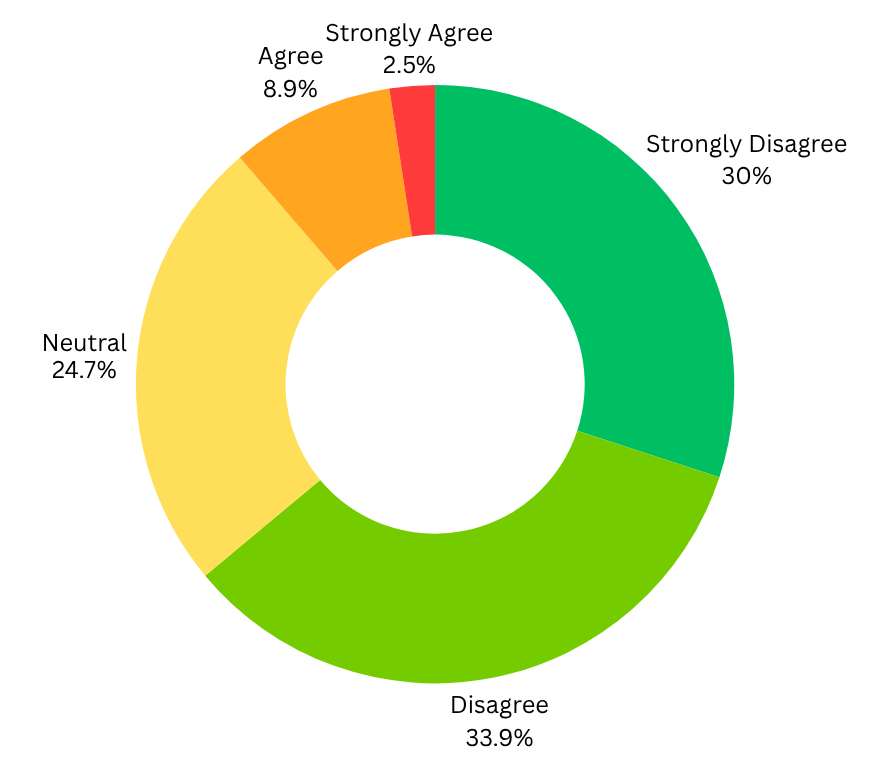
Many Mills students, however, are opposed to the bell-to-bell policy. According to district surveys conducted during spring of 2026, nearly 85% of students supported banning cellphones only during instructional time, while only 8.5% supported a bell-to-bell policy.
“I’m not sure how I’m going to text my mom or my brother … if I forget something, or if I need something,” says Danael Na (11). “There’s a lot of uncertainty.”
Freshman Olivia Cruz is more concerned with enforcement. “No matter what [phone policy] they do, people are going to find a way around it.”
The SMUHSD Student Board Council also sent the Board of Trustees a letter opposing the bell-to-bell ban, reasoning that a policy such as Yondr pouches would fail to fix the real issue of students not paying attention in class.
“In general, technology is something that has become part of our day-to-day lives, so I think that taking it away so suddenly [and] having a full bell-to-bell [policy] would be an extreme,” Sara Joseph, Hillsdale High School’s student representative, argued at the board meeting.
Others think the ban will be beneficial overall.
“It can help [students] give their attention to the teacher, which is probably much needed,” says Madelyn Galura (10).
According to Dilemme, there won’t be many changes inside the classroom since most teachers at Mills already restrict phone use during instructional time.
“Most people already adhere to the cellphone policies,” he says. “So in the classroom, it’s only a few people [who] need to really change what they’re doing.”
However, Cañas-Gonzalez stresses that teachers still have a role to play when the policy takes effect.
“I think teachers need to be ready to support our students with this change, because I think some students might experience withdrawal,” she says. “They might be short tempered, they might feel anxious, and we have to be able to support that and develop community in class.”
Zúñiga also highlights the importance of teaching kids about using and managing technology responsibly.
“It has to be a partnership with the parents and the families,” she says. “That type of education around what happens with the phone, and … talking to kids about being safe, all of that also should come from the folks who are giving them the phones. Now, not every kid has that support at home, [so] that’s when maybe the school steps in. But there has to be buy-in from parents.”
A Mills parent* noted that the bell-to-bell policy could be a big change for families. According to district surveys, only 38.7% of parents favored a bell-to-bell policy, while 56.6% favored banning phones only during instructional time.
“I think that the phones have created an overreliance of students on their parents and that high school students are much more capable of figuring out how to solve their issues,” the parent says, adding later, “At first it might be hard for some parents, but it’s part of letting your kid grow up and be more independent.”
The parent believes that the phone ban will be even more important now. “Kids [will] be forced to talk to each other and be awkward and [will] have to figure out how to go make friends,” they explain. “And I think over time … especially as we move into a more digital AI world, those human skills are going to become more essential.”
Above all, Duszynski emphasizes that the new policy is not intended to be a punishment for students.
“At the center of it, it’s not about trying to control you or regulate you; it’s about trying to support your well-being,” she says.
*The source was granted anonymity out of respect for their child’s privacy.