





















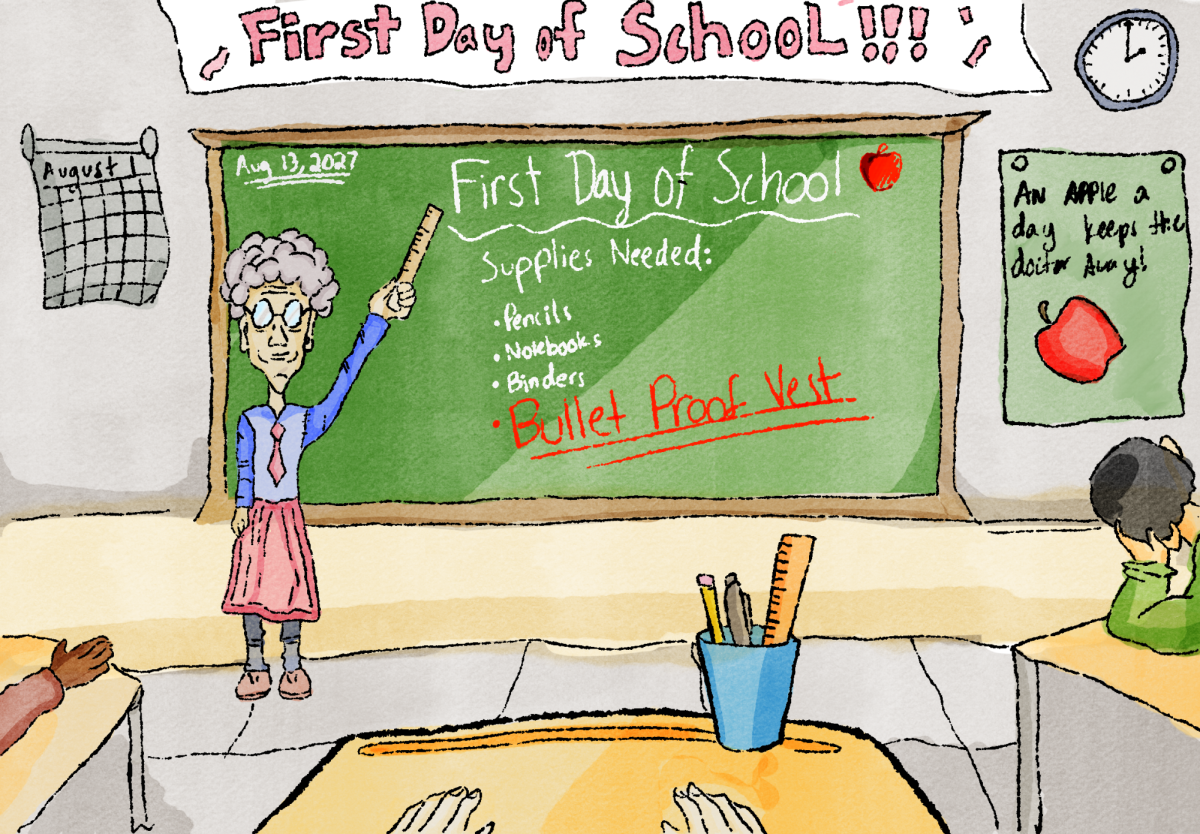


In America, the topic of gun violence is no ordinary discussion. According to the Gun Violence Archive, an independent non-profit organization that provides near-real-time information on gun violence incidents in America, there have been over 349 mass shootings since the start of this year. Although countless incidents go unreported, the ones that do make headlines appear so frequently they’ve almost become routine. With the climb in the dependence on public media to attain breaking news, the frequency of reported gun violence acts began raising a question: has this caused us to become desensitized to gun violence?
For years, America has been at a constant war with conflicting ideals and political opinions. One of the most controversial topics has been the handling of firearms and whether stronger rules must be implemented in order to keep Americans safe.
On September 10th, 2025, American right-wing political debater Charlie Kirk was assassinated with a singular gun shot at an event with thousands in the audience witnessing this brutal occurrence. Hours after the announcement of Kirk’s death, public figures of all political backgrounds across the nation came onto social media to express their strong disapproval towards political violence. At the same time, viewers also began expressing both disappointment and gratitude for the use of a firearm for Kirk’s death. Outraged with the cause of his death, many with similar political views of Kirk voiced their anger towards the opposing party and vice versa, blaming each other for the cause of his death.
On the same day Kirk was shot, a school shooting happened in Colorado at Evergreen High School. Two students were shot and critically injured while the gunman died from self-inflicted wounds. Newsfeeds were covered with Kirk’s assasination with many viewers not knowing of this event. What should have been on the national news was overpowered from the assassination of a notable figure, proving how these shootings are treated as “common” to the point where the media would rather focus on other events.
The constant attention surrounding the shooting of public figures should not be the approach to condemning gun violence. Deciding when to feel bad will not change the way others think of gun brutality.
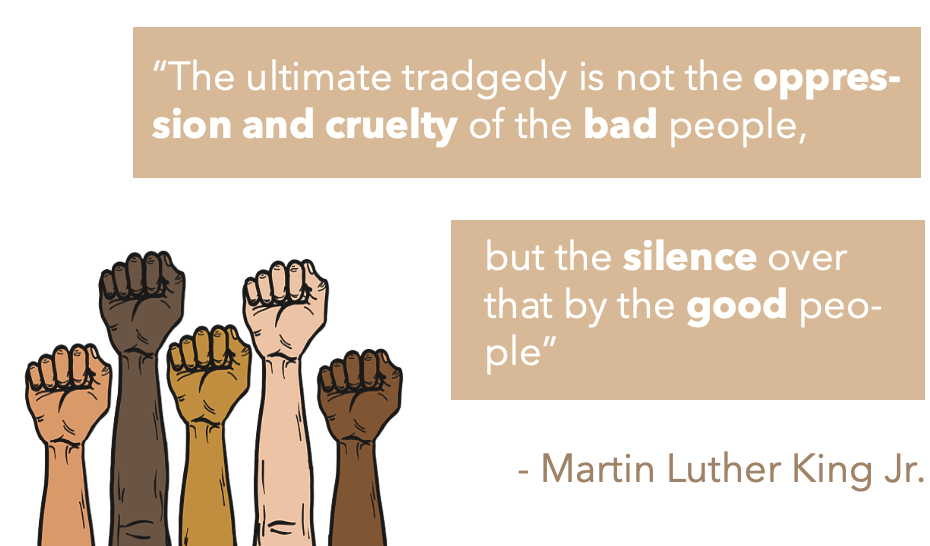
It is clear that the use of firearms will never be the answer to any issues. While these acts are never justified, a deeper concern arises: why do people express outrage over gun violence when it involves a public figure’s death, but not when hundreds of other gun related catastrophes occur? With the everlasting coverage of prominent figures, the discussion of the real issue becomes a matter of selective empathy.
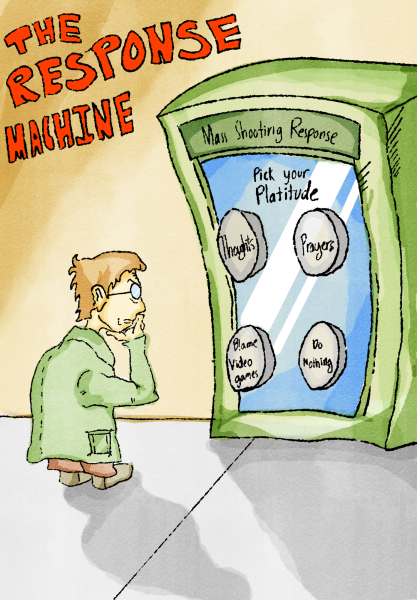
School shootings have been nothing but a tragedy in America. Within the media, the coverage of school shootings has often focused on the perpetrator rather than the actual victims. The angle of reporting influences the reactions of the public, with people discussing “unassociated topics,” such as dissecting the shooter’s path and creating conspiracy theories. While these instances aren’t necessarily always a broadcasted conversation, they are still discussed and spread quickly across social platforms.
These reactions aren’t only evident in cases of school shootings, though. On December 4th, 2024, Luigi Mangione, a 26 year-old American man, shot UnitedHealthcare CEO Brian Thompson claiming the health insurance industry had been corrupted by greed and this was his way of bringing attention to the matter. The murder triggered a variety of mixed reactions from the public, with some expressing disapproval of Mangione’s actions while others glorified and even celebrated him for what he did. At the same time, some responded in different ways, completely ignoring the crime or downplaying it as a joke. A majority of these reactions occurred on social media platforms, with people commenting on posts of Mangione in court, gushing about his appearance, praising his photogenicity, and turning his facial expressions into memes and stickers rather than taking the situation seriously.
The media’s reactions show how the frequency of these situations, regardless of the victim’s identity, has created a sense of normality, causing people to see things at a different, and oftentimes inappropriate, angle. Other than the occasional message sending empty condolences, most ignore the effects these situations have on victims and focus more towards new intriguing or eye-catching information, which in Mangione’s case were his looks and in Kirk’s case were his political views. Now, the public is only surprised when something “interesting” happens because the gun violence aspect is no longer seen as significant, and the media completely disregards the fact that these are life-altering, and possibly ending, traumatic events.
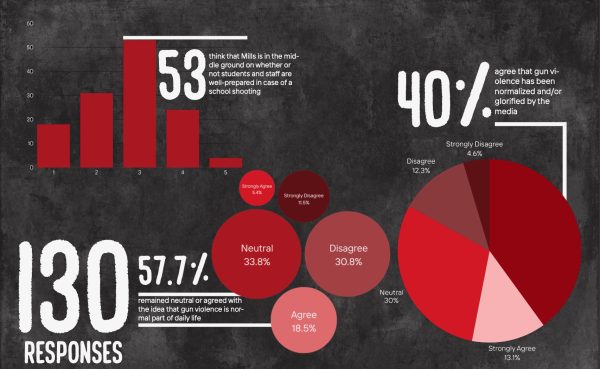
During the fourth week of October, The Thunderbolt surveyed a total of 130 Mills students on their thoughts about the topic of gun violence. In 2024, over 300 shootings occurred at schools around the country, with 83 of them resulting in injuries or death. The data collected included more than half of the participants hypothesizing that there were under 100 school shootings in America in 2024, proving how overlooked gun violence is. Considering how impactful and life altering these events can be, it is surprising to see how often school shootings are brushed over or minimized.
Unequivocally, school shootings have always been a large concern for students in America from all the happenings reported from the news. The frequency of shootings has led to similar reports every time, which have slowly begun to minimize. The discussion of gun violence has gradually become normalized, with people debating over it. Due to the overall conversation online, the algorithm fed to students has created the idea the issue isn’t to be as concerned about. This culture of normalization, although a seemingly harmless means of “coping,” physically manifests itself in dangerous habits with real-life repercussions.
When an emergency happens at school, students are required to follow the safety protocols followed by evacuations practiced from drills. 40% of surveyed students stood in the middle ground on whether or not Mills is well-prepared in case of school shootings with the drills. However, the sense of urgency that typically surrounds these evacuations has completely died down due to the constant setting off of fire alarms at Mills, whether it is triggered by malfunctions, accidents, or vapes. It has become a standard for students to react calmly when an alarm is triggered, with some even celebrating not having to be in class. With smoke detectors having the intended purpose of detecting fires in buildings, the unconcerned reactions from students pose a threat to real safety concerns. One known tactic for school shooters is to pull a fire alarm or have a fire alarm triggered from gunshots. The lack of concern with fire alarms potentially exposes students to immense amounts of danger.
Media coverage of gun violence has created a constant and repetitive exposure to the news which has led to the normalization of the topic, creating an emotionally numbing response. The influence from the media endangers the concern and worry of adolescents as we are common targets to firearm usage.
The media needs to prioritize producing less glorifying depictions of gun violence, as it makes people less emotionally-responsive in real life and less empathetic towards others.