

























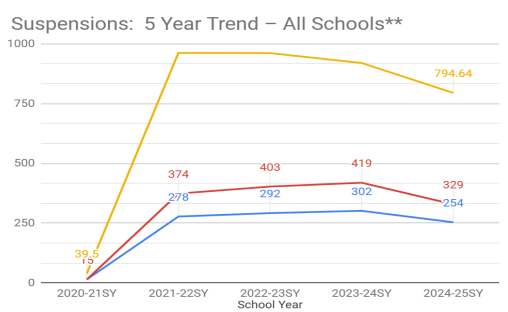
The San Mateo Union High School District recently released statistics on suspension and expulsion rates, presented at the board meeting by Dr. Sheliah Burnette on Nov. 20, 2025. Most significantly, the data revealed a 22% decrease in suspensions compared to the prior year, highlighting the progress made in reducing exclusionary punishments.
Suspensions, which temporarily remove a student from school, are typically imposed for serious offenses such as fighting or possessing drugs/alcohol. The temporary removal from school aims to serve as a wake-up call that the student’s behavior is unacceptable. Additionally, students are suspended if they are deemed a potential threat to the school.
Mills Principal Pamela Duszynski describes how suspension helps address these wrongdoings.
“[Suspension] gives the student and the family time to reflect. It gives the school time to put in other interventions and supports,” Duszynski states. “It sends the message that if you engage in certain decisions or behaviors … you’re not allowed to be a part of the community for that day as a consequence.”
One major drawback to suspension is that students are not engaged in learning while suspended, resulting in instructional time lost. When the number of suspensions is reduced, less class time is lost. According to the data shared at the board meeting, the amount of instructional days lost during the 2024-25 school year was 13.6% less than the previous year.
“[The decrease in suspension rates is] an indication of the students remaining at school instead of being suspended and having sat at home, but it’s also an indication of fewer disciplinary issues at our school,” Duszynski explains. “And that’s a good thing too, [because it means that] many of the students are abiding by the rules and making good decisions, which is preventing having to resort to suspension at all.”
One factor that may have a hand in the decrease is the Alternatives to Suspension program (ATS), which typically consists of group therapy. Students who would otherwise be suspended can be referred to participate in the program.
“[ATS] gives schools an opportunity to provide a different intervention for students, rather than a suspension,” Duszynski says. “For example, if a student is caught vaping in a restroom, instead of suspending them… we can enroll them in a substance use prevention program that they have to complete.” These programs intend to address the root of the misbehavior. They are based on the principle of restorative justice, which is an approach to resolving harm by working with students to fix the problems caused and move forward.
According to Timothy Christian, Dean of Students, a primary value emphasized by restorative justice is accountability.
“[The students are asked], ‘What did you do? What were you thinking about when you did it? What have you thought about since that has happened? [How] could you repair the harm that you caused?’ … It’s kind of a novel concept of having people be accountable for what they did,” Christian explains.
These questions prompt the students to think about what they have done and how they can make things better. As a result, students are less likely to get suspended again after participating in an ATS program. The data presented from the board meeting supports this, as it indicates that 75% of students did not reoffend.
Duszynski believes that the integration of restorative justice represents a change in the district’s mindset regarding disciplinary action.
“[We’ve realized] that we’re really dealing with young people who are making [negative] decisions and choices, and we have an opportunity to help them reflect on what they did and make better decisions in the future,” Duszynski says.